What Is Cryptocurrency Staking and How Does It Work
We explain what cryptocurrency staking is, how Proof-of-Stake works, how much you can earn and what the risks are. A simple explanation for those just getting started with the topic.
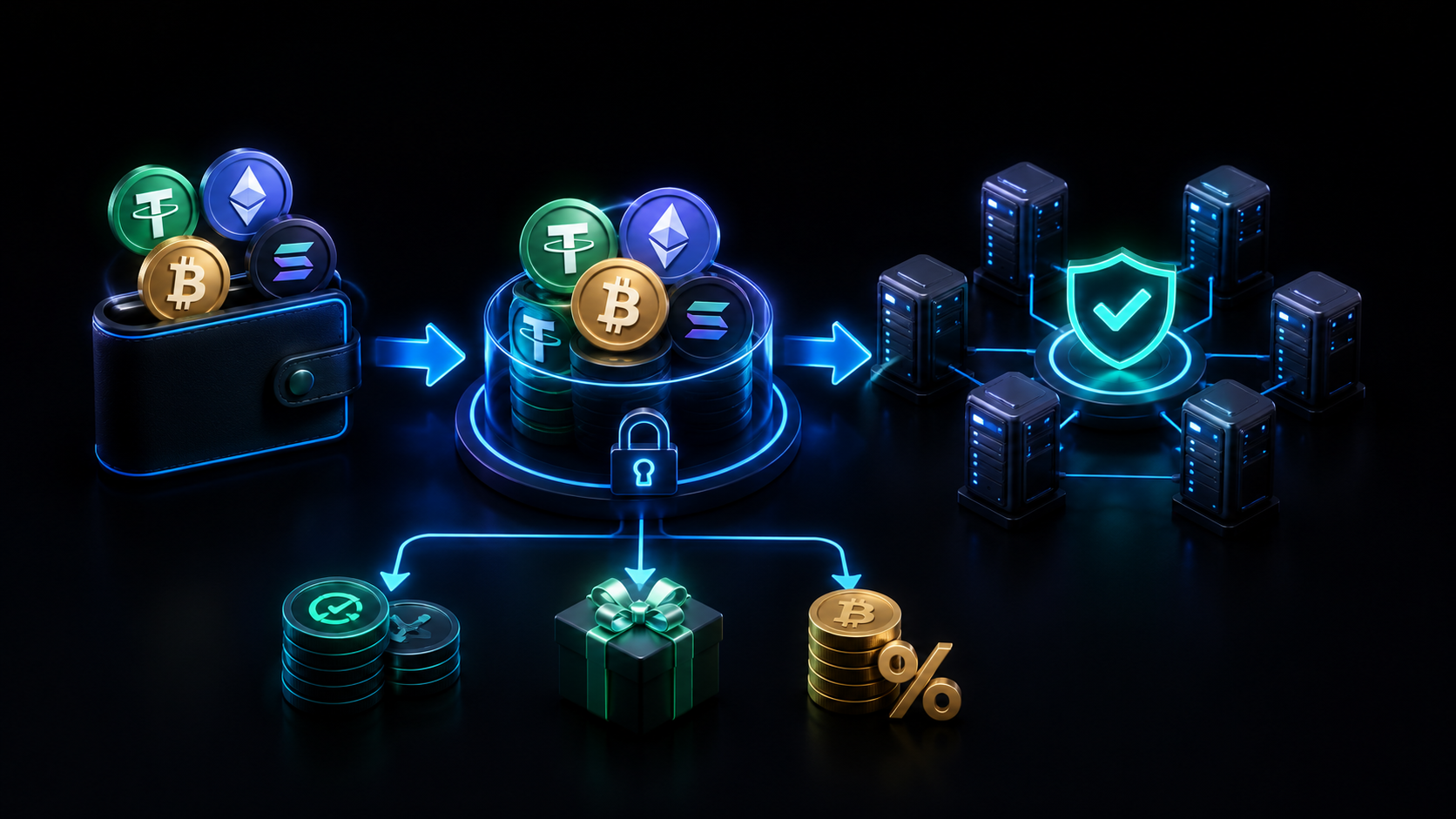
If you have bought Ethereum or other cryptocurrencies through Paybis and are wondering what to do with them next — staking is one option. But before making any decisions, it is worth understanding how it works, what it realistically pays and what risks are involved.
What Staking Is in Simple Terms
Staking is the process of locking cryptocurrency to participate in the operation of a blockchain in exchange for a reward.
To understand the concept you need a basic grasp of Proof-of-Stake — the consensus mechanism used by Ethereum and many other blockchains. Unlike Bitcoin where new blocks are created by miners expending computing power, in Proof-of-Stake new blocks are proposed and confirmed by validators — participants who have locked (staked) a certain amount of cryptocurrency as a guarantee of honest behaviour.
If a validator behaves honestly and correctly — they receive a reward from newly issued coins. If they attempt to cheat the network — they lose part of their stake. This is a mechanism that makes dishonesty financially unattractive.
Staking for an ordinary user does not necessarily mean running a validator node yourself. More often it means delegating your coins through dedicated protocols or exchanges that handle the technical side on your behalf.
How Ethereum Staking Works
Ethereum is the most popular asset for staking. After its transition to Proof-of-Stake in 2022, ETH holders can participate in transaction validation and earn rewards.
Direct staking requires a minimum of 32 ETH and technical expertise to run a validator node. This option is for large holders and technically experienced users.
Liquid staking through protocols like Lido is a more accessible option. You deposit any amount of ETH and receive stETH (staked ETH) tokens in return at a 1:1 ratio — these tokens automatically accumulate rewards. You can exit at any time by selling stETH on a decentralised exchange.
Staking through centralised exchanges is the simplest option. You deposit ETH, the exchange stakes on your behalf and pays you a share of the rewards. Less control, but fewer technical complexities.
How Much You Can Earn
Staking rewards are expressed as APR (Annual Percentage Rate). For Ethereum in 2026, this is typically 3–5% per year in ETH.
An important nuance: rewards are paid in the same cryptocurrency you are staking, not in dollars. If ETH rises over the year — your dollar return will be higher. If it falls — lower, potentially resulting in a loss in dollar terms despite a formally positive APR.
For comparison: traditional bank deposits in euros or dollars in 2026 offer around 2–4% annually. At first glance comparable, but a bank deposit is not subject to the price risk of the underlying asset.
Staking Risks That Are Important to Understand
Staking is not a bank deposit. The risks are fundamentally different.
Price risk. If ETH drops 30% while you are staking — you receive a reward in ETH but lose in dollar terms. APR does not protect against a decline in the price of the underlying asset.
Smart contract risk. Liquid staking through protocols works via smart contracts. These may contain vulnerabilities. The history of DeFi includes cases where contract bugs led to loss of funds. Even audited contracts offer no absolute guarantee.
Liquidity risk. In some staking schemes funds are locked for a fixed period. If you need to withdraw urgently — this may be impossible or only possible at a loss.
Platform risk. When staking through a centralised exchange you are trusting that exchange. Exchanges go bankrupt and get hacked — there are well-known examples.
Slashing risk. When staking directly through your own validator node, configuration errors can lead to a slashing penalty — a forced burning of part of the staked coins. When using large protocols this risk is minimal.
How Staking Differs from Mining
Both processes serve to secure and operate a blockchain and both generate rewards — but they are fundamentally different.
Mining (Proof-of-Work, Bitcoin) requires specialised hardware — ASIC devices or graphics cards. It competes with thousands of other miners. It consumes significant amounts of electricity. Entry requires capital investment in equipment.
Staking (Proof-of-Stake, Ethereum and others) requires only cryptocurrency. No specialised hardware needed. Minimal energy consumption. Entry is accessible to anyone who holds the coins.
Staking and USDT: Why USDT Is Not Staked in the Traditional Sense
A common question: can USDT purchased through Paybis be staked?
USDT is a stablecoin running on the Ethereum or Tron blockchain. It does not itself participate in Proof-of-Stake validation of those networks — that requires the network's native token (ETH for Ethereum, TRX for Tron).
However, USDT can be used in DeFi protocols to provide liquidity or for lending — this is a different mechanism for generating yield, distinct from staking in the strict sense.
Is Staking Worth It
An honest answer: it depends on your goals and willingness to accept risk.
If you hold ETH long-term and have no plans to sell it in the near future in any case — staking lets you earn additional rewards on coins you already hold. The risks remain the same as for simply holding, plus the technical risks of whichever staking method you choose.
If you are just beginning to explore cryptocurrency — first master basic wallet storage and how transactions work. Staking adds complexity and risks that are better studied after grasping the fundamentals.
Staking purely for income — without understanding the price risk of the underlying asset — is an incomplete view of the picture. A 4% APR in ETH while ETH drops 40% is a loss, not a gain.