What Is Ethereum and What Is It For: An Explanation
We explain what Ethereum is, how it differs from Bitcoin, what it's used for, and why ETH is the second most important cryptocurrency. A simple explanation for beginners.
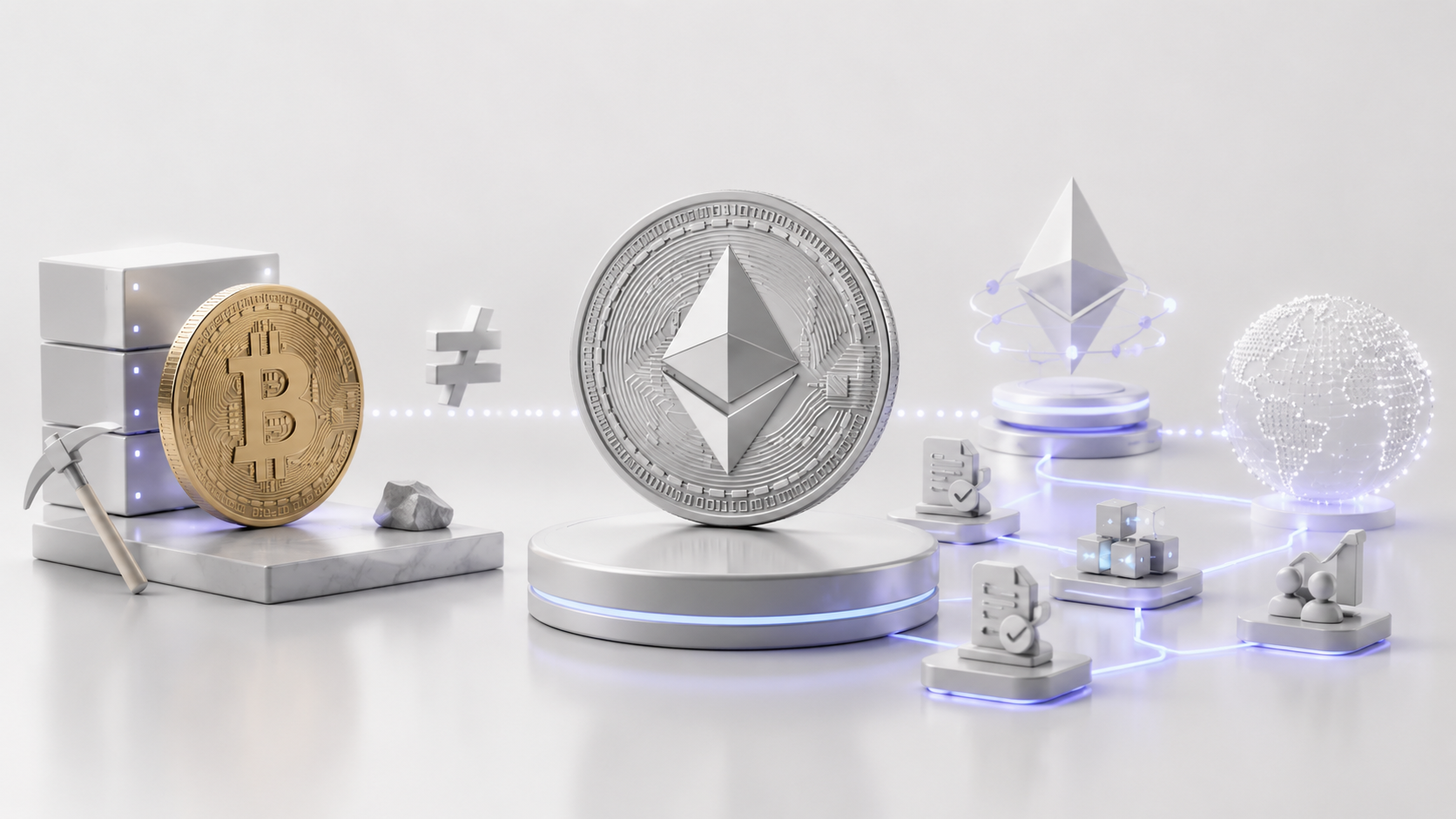
Ethereum is not just another cryptocurrency. It is a programmable blockchain on which smart contracts, decentralised applications, and most tokens run — including USDT on the ERC-20 network. ETH is the native currency of this network, needed to pay for operations within it. This article explains how Ethereum fundamentally differs from Bitcoin, what a "programmable blockchain" means in practice, and why ETH has held second place by market capitalisation for many years.
The Main Difference from Bitcoin: A Blockchain as a Computer
Bitcoin was created with a single purpose — to be decentralised digital money and a store of value. That's exactly what it does: it stores records of who owns which bitcoins and allows them to be transferred.
Ethereum was conceived differently from the start. Vitalik Buterin, who proposed the concept in 2013 and launched the network in 2015, wanted to create a programmable blockchain — not just storing transaction records, but executing arbitrary code.
A simplified analogy: Bitcoin is a calculator, a specialised tool that does one thing well. Ethereum is a computer on which you can run any programme.
This is precisely what makes Ethereum the foundation for: smart contracts (programmes that execute automatically when conditions are met), DeFi protocols (decentralised financial services), NFTs (unique digital tokens), and thousands of other tokens and applications running on top of the Ethereum blockchain.
ETH: Why the Network's Native Currency Is Needed
ETH is not just another token — it's the fuel that powers the entire Ethereum network.
Every operation on the Ethereum network — sending tokens, interacting with a smart contract, creating an NFT — requires paying a fee in ETH. This fee is called "gas" and compensates the computational resources that network nodes spend processing operations.
No ETH means no operations. Even if you want to send USDT on the Ethereum network (ERC-20), you need a small amount of ETH in your wallet balance to pay for gas. This is why beginners sometimes encounter the situation of "I bought USDT but can't send it" — there's no ETH to pay the network fee.
The gas price is dynamic and depends on network congestion: the more users sending transactions simultaneously, the greater the competition for block space and the higher the fee. During peak DeFi activity or NFT hype, fees on the Ethereum network can be quite significant.
Proof-of-Stake: How Ethereum Secures the Network Today
In September 2022, Ethereum went through one of the largest technological events in cryptocurrency history — the transition from Proof-of-Work (mining) to Proof-of-Stake (staking). This event was called "The Merge".
Before The Merge, Ethereum worked like Bitcoin — miners spent computing power and electricity to secure the network. After the transition, the network is secured by validators — participants who have locked ETH as a guarantee of honest behaviour.
Results of the transition: Ethereum's network energy consumption dropped by approximately 99.95% compared to the mining period. This radically changed Ethereum's environmental profile and made the comparison "cryptocurrency = massive CO₂ emissions" outdated, at least as applied to Ethereum.
The Ethereum Ecosystem: Why So Many Need ETH
The value of ETH is largely determined by how actively the Ethereum network is used, and the ecosystem around it is enormous.
ERC-20 tokens. Most well-known tokens — USDT, USDC, UNI, LINK, hundreds of others — are smart contracts on the Ethereum network. Sending them requires ETH.
DeFi (decentralised finance). Exchanges without intermediaries, lending protocols, liquidity staking — most DeFi activity happens in the Ethereum ecosystem and requires ETH to pay for operations.
NFTs. Most NFT collections are issued on the Ethereum network — buying, selling, and transferring NFTs requires ETH.
Layer 2 networks. To reduce fees and increase speed, "second-layer networks" were created on top of Ethereum — Arbitrum, Optimism, Base and others. They inherit Ethereum's security but have significantly lower fees.
Ethereum vs Bitcoin: Not Competitors but Different Tools
This question arises for almost everyone studying both cryptocurrencies. The answer: they were built for different purposes.
Bitcoin is digital gold. Limited supply (21 million), maximum decentralisation, a minimalist protocol that is difficult to change. Primary use — long-term store of value.
Ethereum is a programmable platform. A flexible protocol that actively evolves, a vast ecosystem of applications built on top of it, regular technological upgrades. Primary use — the foundation for decentralised applications and tokens.
Historically Bitcoin and Ethereum have shown significant price correlation (both rise in bull markets and fall in bear markets), but their long-term dynamics can differ depending on how widely demanded the ecosystem of Ethereum-based applications becomes.
Where to Buy ETH and How to Store It
Ethereum is available to buy on Paybis with a Visa or Mastercard. The process is standard: select ETH in the converter, provide your Ethereum network wallet address, pay by card.
An important practical detail already mentioned above: when buying ETH for use in DeFi or for sending ERC-20 tokens, make sure you buy enough ETH to cover not just the main amount but also future gas fees. Buying ETH for "exactly what's needed" without a gas reserve is a common beginner mistake.
For storing ETH, the same non-custodial wallets suitable for Bitcoin work well — MetaMask, Trust Wallet, Ledger. MetaMask is especially popular for interacting with DeFi applications as it was originally built specifically for the Ethereum ecosystem.
Frequently Asked Questions
How does ETH differ from USDT on the Ethereum network (ERC-20)? ETH is the native currency of the Ethereum network, required to pay fees for any operations on that network. USDT ERC-20 is a token running on top of the Ethereum network as a smart contract. To send USDT ERC-20 you need ETH in your balance to pay gas — they are different assets with different functions, even though both exist on the same network.
Why can gas fees on the Ethereum network be so high? The gas price is determined by competition among users for limited block space. When the network is congested, many users raise the fee they offer so their transaction gets processed faster, which drives up the average gas price. For small transactions during periods of high fees, it makes more sense to use Layer 2 networks (Arbitrum, Optimism) with the same capabilities but significantly lower fees.
Can you lose ETH due to a bug in a smart contract? Yes, this is a real risk when interacting with DeFi protocols. If a smart contract's code contains a vulnerability, an attacker can exploit it to drain funds from the protocol. To reduce risk: only interact with established, long-running protocols with independent security audits, and don't put into new unvetted projects more than you're willing to lose.
Is it safe to keep ETH in a Paybis account rather than withdrawing to a personal wallet? Paybis is a fiat gateway, not a custodial wallet for long-term storage. After purchase, ETH is automatically sent to your specified personal wallet — Paybis does not hold users' cryptocurrency. If you plan to hold ETH long-term, use a personal non-custodial wallet or hardware wallet.
What is Ethereum Layer 2 and do I need to know about it when buying ETH through Paybis? Layer 2 networks run on top of the main Ethereum blockchain to reduce fees and increase transaction speed. When buying ETH through Paybis, you receive it on the main Ethereum network (Mainnet). Moving to Layer 2 networks is a separate step done from your personal wallet if you plan to actively use DeFi applications.