What Is Bitcoin Mining and Halving in Simple Terms
We explain what cryptocurrency mining is and what Bitcoin halving means: how it works, why it's needed, and how it affects the price. In simple terms for those hearing these terms for the first time.
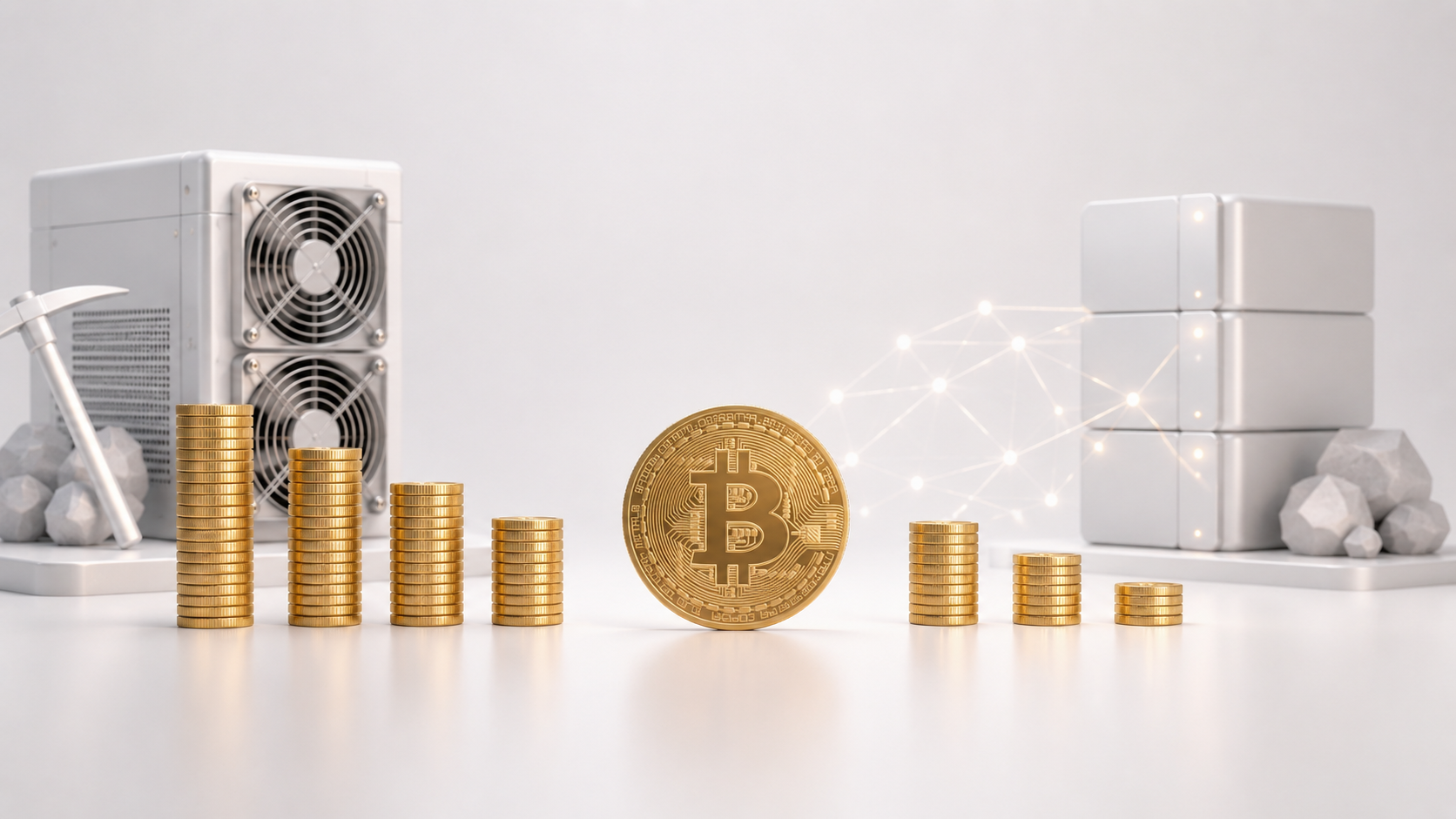
Mining is the process of creating new bitcoins and confirming transactions by solving complex computational problems using specialised hardware. Halving is a reduction in miners' reward built into Bitcoin's code, cutting it exactly in half every 210,000 blocks (roughly every four years). Together these two mechanisms determine how new bitcoins are created and why their total supply is limited. Let's look at how this works and why it's worth understanding even if you simply buy cryptocurrency rather than mine it.
What Mining Actually Is
Mining isn't "digging" in the literal sense, even though the name suggests that association. In reality, it's a process that secures and operates the blockchain.
Miners are network participants with powerful computing hardware who compete for the right to add a new block of transactions to the blockchain. To add a block, they need to solve a complex mathematical problem — essentially trying enormous numbers of random number guesses until finding one that fits. This is called Proof-of-Work.
The first miner to find the correct solution gets the right to record the new block and receives a reward in newly created bitcoins plus the transaction fees from that block. Other miners verify the solution and move on to working on the next block.
Why this matters: this system makes fraud or transaction tampering practically impossible. To alter already-recorded transaction history, an attacker would need to recalculate all subsequent blocks faster than the rest of the network of miners combined — which requires enormous computing power and becomes economically unviable.
Mining Hardware: From a Laptop to Industrial Farms
In Bitcoin's early years (2009-2010), mining could be done on an ordinary home computer. Today it requires specialised hardware.
ASIC devices (Application-Specific Integrated Circuit) are chips designed exclusively for one task — mining using a specific algorithm. They are orders of magnitude more efficient than regular processors or graphics cards for this narrow task, but useless for anything else.
Mining farms are facilities with hundreds or thousands of ASIC devices running simultaneously, usually located where electricity is cheap, since electricity costs make up the bulk of mining expenses.
Mining pools are groups of miners who combine their computing power and split the reward proportionally to each participant's contribution. Alone, an individual miner's chance of finding a block against the entire network is extremely small — pools provide more predictable and stable income.
An important honest detail: for an ordinary person, home Bitcoin mining in 2026 is economically impractical — equipment and electricity costs in most regions exceed the potential income at the network's current difficulty. Mining remains a profitable business at the industrial level only with access to very cheap electricity and specialised hardware.
What Halving Is and Why It's Programmed Into Bitcoin
Halving is a reduction of the block mining reward by exactly half, occurring automatically every 210,000 blocks according to Bitcoin's protocol code, without any central decision.
Originally in 2009, the block reward was 50 BTC. After the first halving in 2012, it dropped to 25 BTC. Then sequentially: 12.5 BTC after the second halving in 2016, 6.25 BTC after the third in 2020, 3.125 BTC after the fourth in 2024. The next halving is expected around 2028, when the reward will drop to 1.5625 BTC.
Why this matters: halving is a mechanism that ensures a limited and predictable supply of Bitcoin. The total number of coins that will ever be created is fixed at 21 million — a hard limit built into the protocol's code. Halvings gradually slow the pace of new coin issuance, bringing the total supply toward this limit along a diminishing curve rather than evenly.
This mechanism fundamentally distinguishes Bitcoin from traditional fiat currencies, whose issuance is controlled by central banks and can theoretically be increased without a hard upper limit.
How Halving Affects Price: An Honest View Without Speculation
This is the question almost everyone who's heard of halving cares about, and maximum honesty matters here rather than popular oversimplified narratives.
The logic often cited: halving reduces the inflow of new coins onto the market while demand stays the same or grows — basic economic logic suggests that reducing supply with the same demand should raise the price.
What historical analysis shows: after each of the past halvings, Bitcoin did show significant price growth over the following 12-18 months. But this is a historical correlation across a very small sample of events (only four halvings as of 2026), not a proven causal relationship guaranteed to repeat in the future.
Important limiting factors: the cryptocurrency market today is significantly more mature and institutionalised than during the first halvings, and price is influenced by many other factors — macroeconomic conditions, regulatory news, overall investor sentiment. Anticipation of a halving is also partly priced in beforehand by experienced market participants, which can dampen the effect of the event itself.
Honest conclusion: halving is a real and predictable technological event, but using it as the sole basis for a future price forecast would be an oversimplification. Past results do not guarantee future ones.
Mining Other Cryptocurrencies: It Doesn't Work the Same Everywhere
It's important to understand that not all cryptocurrencies use mining the way Bitcoin does, and not all have a halving.
Ethereum, after its transition to Proof-of-Stake in 2022, no longer uses mining in the traditional sense — instead it uses staking, described in our separate article on staking.
Litecoin uses a Bitcoin-like Proof-of-Work principle with its own algorithm and its own halving schedule, but with different parameters — a different total coin limit and a different reward-reduction frequency.
Many modern cryptocurrencies don't use mining at all as a mechanism for creating new coins — their approach to issuance is determined individually by each project's protocol.
Do You Need to Understand Mining to Buy Cryptocurrency
No, for an ordinary purchase of cryptocurrency through a service like Paybis, understanding the mechanics of mining and halving is not a necessary technical requirement.
But understanding these mechanisms helps you meaningfully navigate the crypto industry's news cycle, understand why Bitcoin has a limited supply unlike ordinary money, and critically evaluate simplified price predictions that are often tied solely to halving dates without accounting for other market factors.
Frequently Asked Questions
Can you make money mining Bitcoin at home on a regular computer in 2026? Practically no — the current difficulty of the Bitcoin network requires specialised ASIC devices, and even with them, profitability heavily depends on electricity costs in your region. For most individual users, buying cryptocurrency directly is economically more rational than trying to mine it yourself.
When will the next Bitcoin halving take place? The next halving is expected around 2028, when the block reward will drop from the current 3.125 BTC to 1.5625 BTC. The exact date depends on the network's block creation speed and may shift slightly, since halving is tied to block count rather than a calendar date.
What will happen once all 21 million bitcoins have been mined? Based on the current pace of halvings, this is calculated to happen around the year 2140. After that point, no new bitcoins will be created, and miners will earn rewards only from transaction processing fees, with no block reward.
Does halving affect transaction fees (gas) on the Bitcoin network? Halving doesn't directly change transaction fees — they're determined by network congestion and competition among users for block space, not by the size of the miner reward. It could have an indirect effect if reduced rewards push some miners off the network, potentially slowing transaction processing speed during a transition period.
How does Proof-of-Work differ from Proof-of-Stake in simple terms? Proof-of-Work (used by Bitcoin) requires participants to expend computing power and electricity to solve mathematical problems. Proof-of-Stake (used by Ethereum since 2022) instead requires participants to lock up a certain amount of cryptocurrency as a guarantee of honest behaviour — without intensive computation and with far lower energy consumption.